
Department of Artificial Intelligence and Data Science
The Department of Artificial Intelligence and Data Science (AIDS) of Jeppiaar Engineering Collegeis dedicated to nurturing future-ready professionals who can thrive in a world increasingly shaped by smart technologies and data-driven systems. With the growing impact of AI across industries, this program provides students with a strong foundation in intelligent computing and analytical thinking.
Why Study Artificial Intelligence and Data Science?
Artificial Intelligence (AI) and Data Science are reshaping how we live, work, and interact with technology. From voice assistants and recommendation systems to smart healthcare and financial forecasting, AI is at the heart of today’s technological transformation. This program helps students understand how machines can learn from data, identify patterns, and make informed decisions.
By combining core concepts from computer science, mathematics, and statistics, the curriculum enables students to build intelligent solutions and develop systems capable of handling real-world challenges. Students also gain insights into ethical AI development and responsible data handling practices.
Key Benefits of the Program
- Practical Skill Development: Emphasis on hands-on training using current AI frameworks, programming tools, and data visualization platforms.
- Multidisciplinary Learning: Students explore a mix of subjects including machine learning, data analytics, natural language processing, and computer vision.
- Industry Integration: Opportunities to work on live projects, internships, and research collaborations with tech companies and academic institutions.
- Strong Career Prospects: The program equips graduates to work in AI development, data analysis, research, and emerging technology roles.
Future Scope and Career Pathways
The demand for professionals skilled in AI and data science is rising across every sector—from IT and finance to healthcare and agriculture. Graduates from this department are well-positioned for roles such as:
- Machine Learning Engineer
- Data Analyst / Data Scientist
- AI Researcher
- Business Intelligence Analyst
- Automation Specialist
- Cloud AI Developer
In addition to immediate employment, students may also pursue advanced studies or contribute to innovative research in the field of artificial intelligence and data systems.
Vision of the Department
To emerge as a globally prominent department, developing ethical computer professionals, innovators and entrepreneurs with academic excellence through quality education and research.
Mission of the Department:
M1 To create computer professionals with an ability to identify and formulate the engineering problems and also to provide innovative solutions through effective teaching learning process.
M2 To strengthen the core-competence in computer science and engineering and to create an ability to interact effectively with industries.
M3 To produce engineers with good professional skills, ethical values and life skills for the betterment of the society.
M4 To encourage students towards continuous and higher level learning on technological advancements and provide a platform for employment and self-employment.
Program Outcomes (POs):
| PO1 | Engineering knowledge: Apply the knowledge of mathematics, science, engineering fundamentals, and an engineering specialization to the solution of complex engineering problems. |
| PO2 | Problem analysis: Identify, formulate, review research literature, and analyze complex engineering problems reaching substantiated conclusions using first principles of mathematics, natural sciences, and engineering sciences. |
| PO3 | Design/development of solutions: Design solutions for complex engineering problems and design system components or processes that meet the specified needs with appropriate consideration for the public health and safety, and the cultural, societal, and environmental considerations |
| PO4 | Conduct investigations of complex problems: Use research-based knowledge and research methods including design of experiments, analysis and interpretation of data, and synthesis of the information to provide valid conclusions. |
| PO5 | Modern tool usage: Create, select, and apply appropriate techniques, resources, and modern engineering and IT tools including prediction and modeling to complex engineering activities with an understanding of the limitations. |
| PO6 | The engineer and society: Apply reasoning informed by the contextual knowledge to assess societal, health, safety, legal and cultural issues and the consequent responsibilities relevant to the professional engineering practice. |
| PO7 | Environment and sustainability: Understand the impact of the professional engineering solutions in societal and environmental contexts, and demonstrate the knowledge of, and need for sustainable development. |
| PO8 | Ethics: Apply ethical principles and commit to professional ethics and responsibilities and norms of the engineering practice. |
| PO9 | Individual and team work: Function effectively as an individual, and as a member or leader in diverse teams, and in multidisciplinary settings. |
| PO10 | Communication: Communicate effectively on complex engineering activities with the engineering community and with society at large, such as, being able to comprehend and write effective reports and design documentation, make effective presentations, and give and receive clear instructions. |
| PO11 | Project management and finance: Demonstrate knowledge and understanding of the engineering and management principles and apply these to one’s own work, as a member and leader in a team, to manage projects and in multidisciplinary environments. |
| PO12 | Life-long learning: Recognize the need for, and have the preparation and ability to engage in independent and life-long learning in the broadest context of technological change. |
List of PSO:
| PSO1 | Exhibit design and programming skills to build and automate business solutions using cutting edge technologies. |
| PSO2 | Strong theoretical foundation leading to excellence and excitement towards research, to provide elegant solutions to complex problems |
| PSO3 | Ability to work effectively with various engineering fields as a team to design, build and develop system applications. |
Program Educational Objectives (PEOs)
| PEO1 | • Apply their technical competence in computer science to solve real world problems,with technical and people leadership |
| PEO2 | • Conduct cutting edge research and develop solutions on problems of social relevance. |
| PEO3 | • Work in a business environment, exhibiting team skills, work ethics, adaptability and lifelong learning. |
Click the below link to download the regulation.
LAB FACILITIES
Adequate and well equipped laboratories: 04 Labs
Additional facilities: 04 Labs
Internet Facility : 300 Mbps Bandwidth
Data Science Research and Project Laboratory: 01 Lab
UPS (20KVA): 02 Nos
Projector: 02 Nos
White Board: 09 Nos (One per Lab)
Technical Staff:
Lab Instructors
Gurunathan A K
ADEQUATE AND WELL EQUIPPED LABORATORIES: 04
Problem Solving and Python Programming Laboratory
Data Structures and Algorithms Laboratory
Artificial Intelligence and Data Science Laboratory
Networks Laboratory
ADDITIONAL FACILITIES: 04
Centre for Data Analytics CoE – Imarticus Learning
Center of Excellence – Virtusa Laboratory
Hardware and Troubleshooting Laboratory
Skill development Laboratory & Internet Facility (300 Mbps Bandwidth)
Data Science Research and Project Laboratory: 01
SYSTEM SPECIFICATIONS
S.NO Lab Name Name of Equipment Number of Equipment Model and Specification
1 Problem Solving and Python Programming Laboratory Computer 36 Intel Core i3 – 6100 CPU @3.70 GHZ Processor 4 GB RAM OS – Ubuntu 16.04 LTS
2 Data Structures and Algorithms Laboratory Computer 36 Intel Core i3 – 6100 CPU @3.70 GHZ Processor 4 GB RAM OS – Ubuntu 16.04 LTS
3 Artificial Intelligence and Data Science Laboratory Computer 36 Intel Core i3 – 6100 CPU @3.70 GHZ Processor 4 GB RAM OS – Ubuntu 16.04 LTS
4 Cloud Computing Laboratory Computer 36 Intel Core i3 – 6100 CPU @3.70 GHZ Processor 4 GB RAM OS – Ubuntu 16.04 LTS
5 Cloud Computing Laboratory Computer 36 Intel Core i3 – 6100 CPU @3.70 GHZ Processor 4 GB RAM OS – Ubuntu 16.04 LTS
SOFTWARE AND OPERATING SYSTEMS
Operating Systems:
Windows 10
Linux Ubuntu
Softwares:
Dev C++
Eclipse
ArgoUML
MySQL
Visual Studio Code
Android Studio
PostgreSQL
Java
Python
MATLAB
Tools:
Lex
YACC (Yet Another Compiler Compiler)
JDK (Java Development Kit)
Servers:
Apache HTTP Server
Apache Server
WAMP/XAMPP
Packages:
Cloudsim
NS2
GCC compiler (GNU compiler collection)
Maintenance and overall ambiance:
Stock register maintenance
Routine equipment check-up
Regular maintenance of computers
Minor repairs by lab technical staff
Major repairs outsourced per institute procedure
Periodic updating of OS and software
Installation of security software
Overall Ambience:
Laboratories allocated on a timetable basis
Weekly lab sessions for practical courses
Good condition of chairs and benches
Individual chairs provided for students
Do’s and Don’ts listed in the laboratory
Entry register for students to sign with system number, in and out time
Adequate hardware and licensed software for curriculum needs
Distribution of sufficient laboratory manuals to students
Conducting laboratory classes according to curriculum
Adequate ventilation and natural light with at least one exit per lab
Effective lighting system
White/black boards, computers, and Internet access
Labs available beyond college hours for research
Safety measures in laboratories :
General Rules of Conduct displayed
Specific Safety Rules for students posted
First aid boxes and fire extinguishers accessible
Uninterruptible Power Supplies (UPS) in place
Regular servicing of lab equipment
Clean and organized lab environment maintained &Cell phone usage restricted or Prohibited
Sand buckets for
Computer systems with up-to-date antivirus software
Implementation of proper grounding and earthing measures

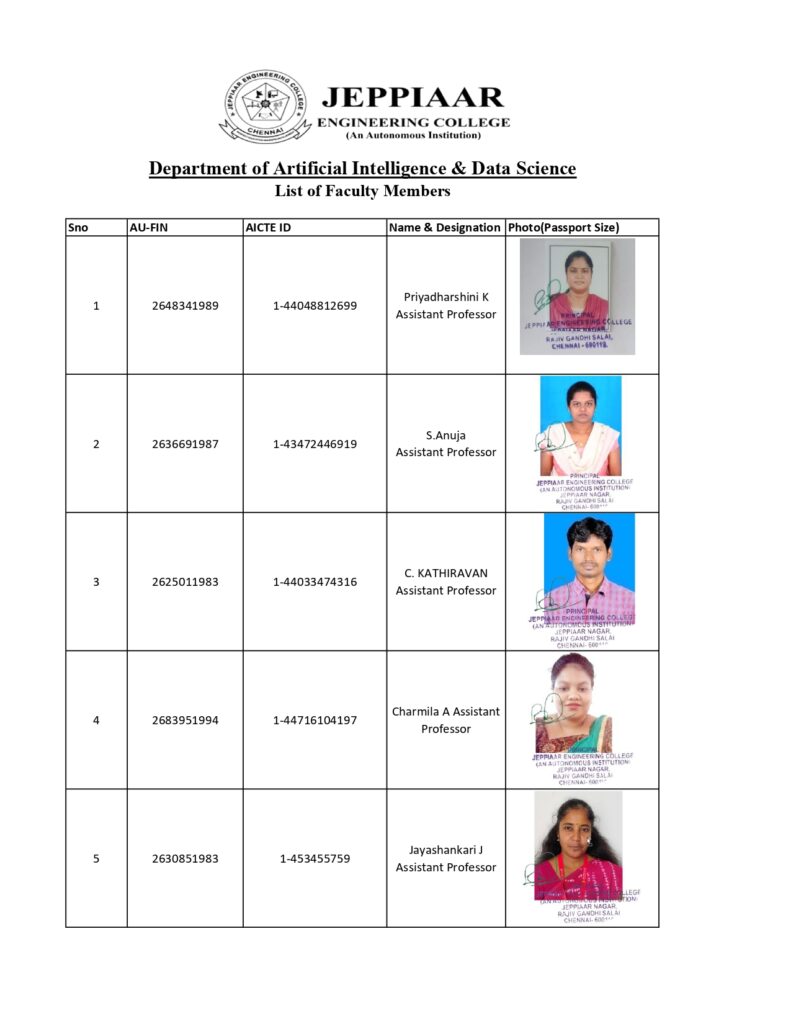
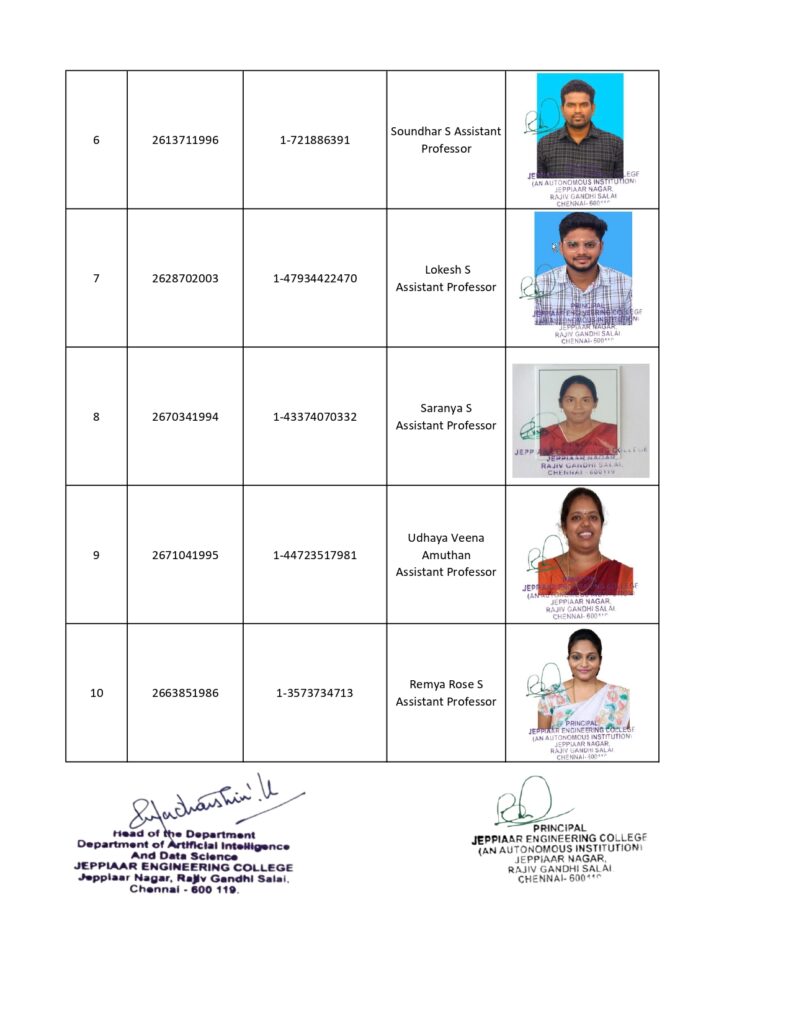
student activities
RESEARCH AND DEVELOPMENT – PUBLICATIONS
INNOVATIVE TEACHING
REPORT
Achievements
B.E. COMPUTER SCIENCE AND ENGINEERING (AIML)
Technical, society activities
Computer Society of India (CSI)
IEEE
IEEE CS
Contact Details:
HEAD OF THE DEPARTMENT
DEPARTMENT OF ARTIFICIAL INTELLIGENCE AND DATA SCIENCE,
JEPPIAAR ENGINEERING COLLEGE,
JEPPIAAR NAGAR, RAJIV GANDHI SALAI, CHENNAI-119.
Phone no:044 2450 2818 Extn: 134
Email: aids@jeppiaarcollege.org
Data Science
The Department of Artificial Intelligence and Data Science (AIDS) of Jeppiaar Engineering Collegeis dedicated to nurturing future-ready professionals who can thrive in a world increasingly shaped by smart technologies and data-driven systems. With the growing impact of AI across industries, this program provides students with a strong foundation in intelligent computing and analytical thinking.
Why Study Artificial Intelligence and Data Science?
Artificial Intelligence (AI) and Data Science are reshaping how we live, work, and interact with technology. From voice assistants and recommendation systems to smart healthcare and financial forecasting, AI is at the heart of today’s technological transformation. This program helps students understand how machines can learn from data, identify patterns, and make informed decisions.
By combining core concepts from computer science, mathematics, and statistics, the curriculum enables students to build intelligent solutions and develop systems capable of handling real-world challenges. Students also gain insights into ethical AI development and responsible data handling practices.
Key Benefits of the Program
- Practical Skill Development: Emphasis on hands-on training using current AI frameworks, programming tools, and data visualization platforms.
- Multidisciplinary Learning: Students explore a mix of subjects including machine learning, data analytics, natural language processing, and computer vision.
- Industry Integration: Opportunities to work on live projects, internships, and research collaborations with tech companies and academic institutions.
- Strong Career Prospects: The program equips graduates to work in AI development, data analysis, research, and emerging technology roles.
Future Scope and Career Pathways
The demand for professionals skilled in AI and data science is rising across every sector—from IT and finance to healthcare and agriculture. Graduates from this department are well-positioned for roles such as:
- Machine Learning Engineer
- Data Analyst / Data Scientist
- AI Researcher
- Business Intelligence Analyst
- Automation Specialist
- Cloud AI Developer
In addition to immediate employment, students may also pursue advanced studies or contribute to innovative research in the field of artificial intelligence and data systems.