
B.Tech CSE with AI & ML is a four-year undergraduate engineering course that combines computer science fundamentals with the technologies used to develop intelligent computer systems.
It is suitable for students who are interested in programming, mathematics, problem-solving, software development and emerging technologies such as artificial intelligence, machine learning and generative AI.
B.Tech in Computer Science and Engineering with Artificial Intelligence and Machine Learning (AI & ML) has promising career prospects because AI is increasingly being used in software development, healthcare, finance, manufacturing, education, biotechnology and other industries.
The course offers opportunities in both traditional IT careers and emerging AI-related fields. Its long-term value depends on the student’s technical skills, practical experience and ability to adapt to new technologies.
Vision of the Department
To emerge as a globally prominent department, developing ethical computer professionals, innovators and entrepreneurs with academic excellence through quality education and research.
Mission of the Department:
| M1 | To create computer professionals with an ability to identify and formulate the engineering problems and also to provide innovative solutions through effective teaching learning process. |
| M2 | To strengthen the core-competence in computer science and engineering and to create an ability to interact effectively with industries. |
| M3 | To produce engineers with good professional skills, ethical values and life skills for the betterment of the society. |
| M4 | To encourage students towards continuous and higher level learning on technological advancements and provide a platform for employment and self-employment. |
Program Outcomes (POs):
| PO1 | Engineering knowledge: Apply the knowledge of mathematics, science, engineering fundamentals, and an engineering specialization to the solution of complex engineering problems. |
| PO2 | Problem analysis: Identify, formulate, review research literature, and analyze complex engineering problems reaching substantiated conclusions using first principles of mathematics, natural sciences, and engineering sciences. |
| PO3 | Design/development of solutions: Design solutions for complex engineering problems and design system components or processes that meet the specified needs with appropriate consideration for the public health and safety, and the cultural, societal, and environmental considerations |
| PO4 | Conduct investigations of complex problems: Use research-based knowledge and research methods including design of experiments, analysis and interpretation of data, and synthesis of the information to provide valid conclusions. |
| PO5 | Modern tool usage: Create, select, and apply appropriate techniques, resources, and modern engineering and IT tools including prediction and modeling to complex engineering activities with an understanding of the limitations. |
| PO6 | The engineer and society: Apply reasoning informed by the contextual knowledge to assess societal, health, safety, legal and cultural issues and the consequent responsibilities relevant to the professional engineering practice. |
| PO7 | Environment and sustainability: Understand the impact of the professional engineering solutions in societal and environmental contexts, and demonstrate the knowledge of, and need for sustainable development. |
| PO8 | Ethics: Apply ethical principles and commit to professional ethics and responsibilities and norms of the engineering practice. |
| PO9 | Individual and team work: Function effectively as an individual, and as a member or leader in diverse teams, and in multidisciplinary settings. |
| PO10 | Communication: Communicate effectively on complex engineering activities with the engineering community and with society at large, such as, being able to comprehend and write effective reports and design documentation, make effective presentations, and give and receive clear instructions. |
| PO11 | Project management and finance: Demonstrate knowledge and understanding of the engineering and management principles and apply these to one’s own work, as a member and leader in a team, to manage projects and in multidisciplinary environments. |
| PO12 | Life-long learning: Recognize the need for, and have the preparation and ability to engage in independent and life-long learning in the broadest context of technological change. |
List of PSO:
| PSO1 | Exhibit design and programming skills to build and automate business solutions using cutting edge technologies. |
| PSO2 | Strong theoretical foundation leading to excellence and excitement towards research, to provide elegant solutions to complex problems |
| PSO3 | Ability to work effectively with various engineering fields as a team to design, build and develop system applications. |
Program Educational Objectives (PEOs)
| PEO1 | • Apply their technical competence in computer science to solve real world problems,with technical and people leadership |
| PEO2 | • Conduct cutting edge research and develop solutions on problems of social relevance. |
| PEO3 | • Work in a business environment, exhibiting team skills, work ethics, adaptability and lifelong learning. |
Click the below link to download the regulation.
LAB FACILITIES
Adequate and well equipped laboratories: 04 Labs
Additional facilities: 04 Labs
Internet Facility : 300 Mbps Bandwidth
Data Science Research and Project Laboratory: 01 Lab
UPS (20KVA): 02 Nos
Projector: 02 Nos
White Board: 09 Nos (One per Lab)
Technical Staff:
Lab Instructors
- Gurunathan A K
ADEQUATE AND WELL EQUIPPED LABORATORIES: 04
- Problem Solving and Python Programming Laboratory
- Data Structures and Algorithms Laboratory
- Artificial Intelligence and Data Science Laboratory
- Networks Laboratory
ADDITIONAL FACILITIES: 04
- Centre for Data Analytics CoE – Imarticus Learning
- Center of Excellence – Virtusa Laboratory
- Hardware and Troubleshooting Laboratory
- Skill development Laboratory & Internet Facility (300 Mbps Bandwidth)
Data Science Research and Project Laboratory: 01
SYSTEM SPECIFICATIONS
| S.NO | Lab Name | Name of Equipment | Number of Equipment | Model and Specification |
| 1 | Problem Solving and Python Programming Laboratory | Computer | 36 | Intel Core i3 – 6100 CPU @3.70 GHZ Processor 4 GB RAM OS – Ubuntu 16.04 LTS |
| 2 | Data Structures and Algorithms Laboratory | Computer | 36 | Intel Core i3 – 6100 CPU @3.70 GHZ Processor 4 GB RAM OS – Ubuntu 16.04 LTS |
| 3 | Artificial Intelligence and Data Science Laboratory | Computer | 36 | Intel Core i3 – 6100 CPU @3.70 GHZ Processor 4 GB RAM OS – Ubuntu 16.04 LTS |
| 4 | Cloud Computing Laboratory | Computer | 36 | Intel Core i3 – 6100 CPU @3.70 GHZ Processor 4 GB RAM OS – Ubuntu 16.04 LTS |
| 5 | Cloud Computing Laboratory | Computer | 36 | Intel Core i3 – 6100 CPU @3.70 GHZ Processor 4 GB RAM OS – Ubuntu 16.04 LTS |
SOFTWARE AND OPERATING SYSTEMS
Operating Systems:
- Windows 10
- Linux Ubuntu
Softwares:
- Dev C++
- Eclipse
- ArgoUML
- MySQL
- Visual Studio Code
- Android Studio
- PostgreSQL
- Java
- Python
- MATLAB
Tools:
- Lex
- YACC (Yet Another Compiler Compiler)
- JDK (Java Development Kit)
Servers:
- Apache HTTP Server
- Apache Server
- WAMP/XAMPP
Packages:
- Cloudsim
- NS2
- GCC compiler (GNU compiler collection)
Maintenance and overall ambiance:
- Stock register maintenance
- Routine equipment check-up
- Regular maintenance of computers
- Minor repairs by lab technical staff
- Major repairs outsourced per institute procedure
- Periodic updating of OS and software
- Installation of security software
Overall Ambience:
- Laboratories allocated on a timetable basis
- Weekly lab sessions for practical courses
- Good condition of chairs and benches
- Individual chairs provided for students
- Do’s and Don’ts listed in the laboratory
- Entry register for students to sign with system number, in and out time
- Adequate hardware and licensed software for curriculum needs
- Distribution of sufficient laboratory manuals to students
- Conducting laboratory classes according to curriculum
- Adequate ventilation and natural light with at least one exit per lab
- Effective lighting system
- White/black boards, computers, and Internet access
- Labs available beyond college hours for research
Safety measures in laboratories :
- General Rules of Conduct displayed
- Specific Safety Rules for students posted
- First aid boxes and fire extinguishers accessible
- Uninterruptible Power Supplies (UPS) in place
- Regular servicing of lab equipment
- Clean and organized lab environment maintained &Cell phone usage restricted or Prohibited
- Sand buckets for
- Computer systems with up-to-date antivirus software
- Implementation of proper grounding and earthing measures

student activities
RESEARCH AND DEVELOPMENT – PUBLICATIONS
INNOVATIVE TEACHING
REPORT
Achievements
B.E. COMPUTER SCIENCE AND ENGINEERING (AIML)
Technical, society activities
- Computer Society of India (CSI)
- IEEE
- IEEE CS
Contact Details:
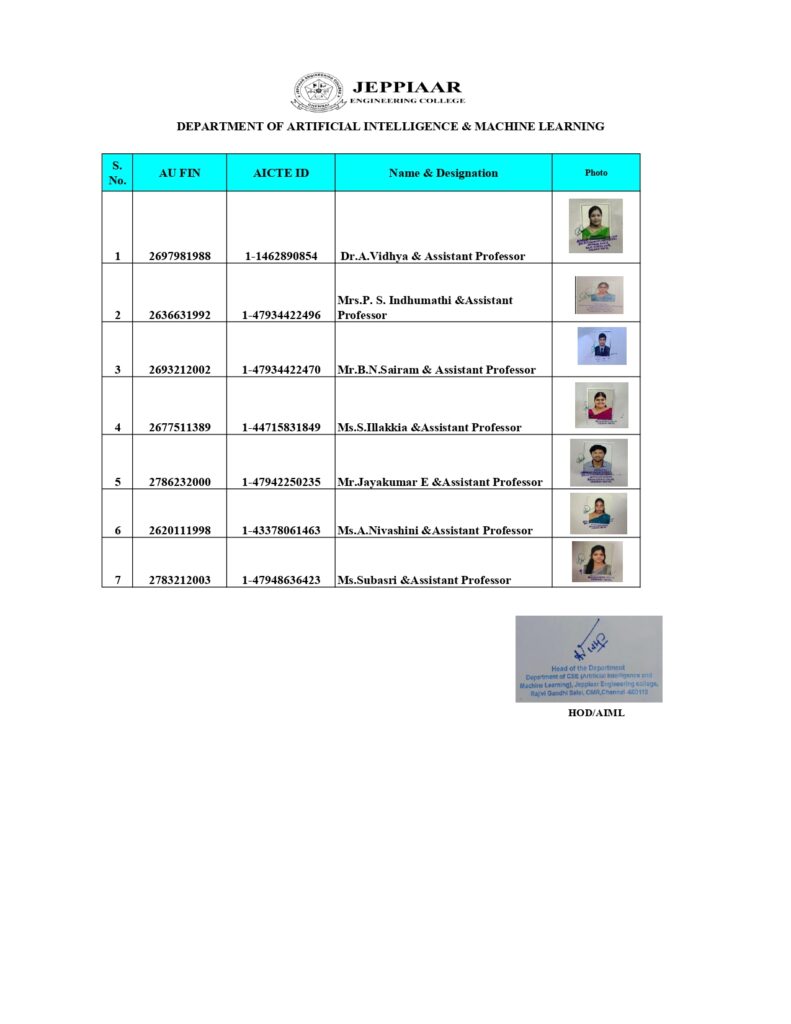
Dr. VIDHYA., M.E.,Ph.D
Professor & Head
DEPARTMENT OF COMPUTER SCIENCE (AIML),
JEPPIAAR ENGINEERING COLLEGE,
JEPPIAAR NAGAR, RAJIV GANDHI SALAI, CHENNAI-119.
Phone no:
044 2450 2818
Extn: 134
Email:
aiml@jeppiaarcollege.org